
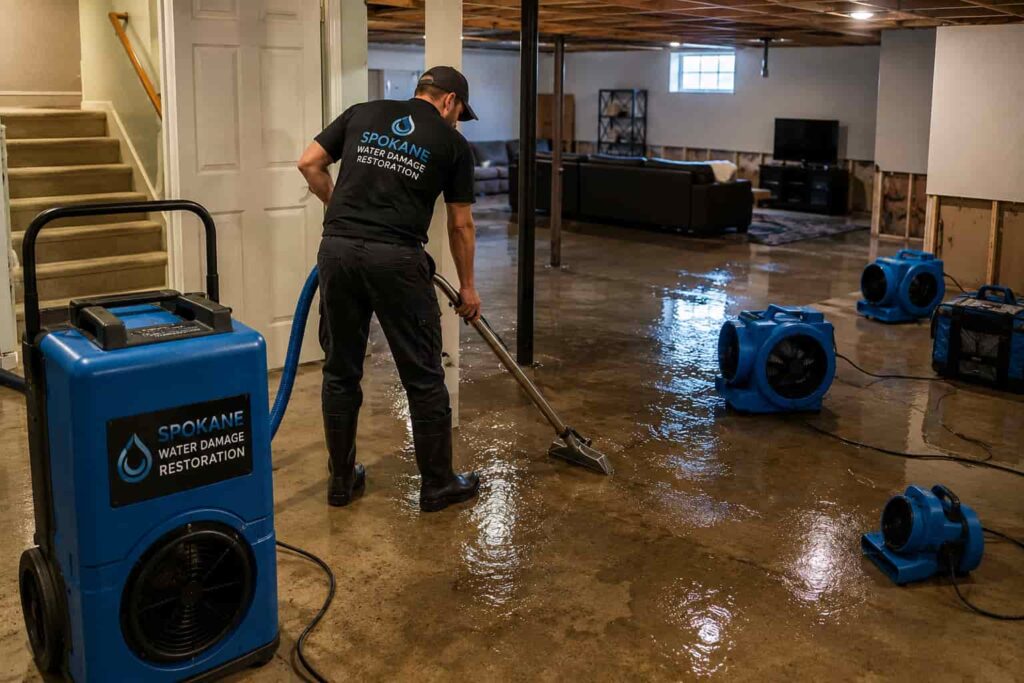
Flood damage in Spokane usually starts in one of a few ways: a storm that overloads the drainage around the house, spring snowmelt pushing groundwater against the foundation, a sump pump that quits, or a sewer line that backs up into the lowest floor. The source matters because it tells us what kind of water we are dealing with, and that decides how the cleanup has to be done.
Our flood damage cleanup runs from getting the water out to proving the structure is dry, using moisture readings rather than guesswork. If water is in your home right now, call (509) 730-2838 and we will start with the steps below.
What to Do Before We Arrive
- Stay out of standing water if an outlet, cord or appliance is in it. Shut off power at the panel only if you can reach it without stepping in water.
- If a supply line or main is the source, close the main water valve.
- Photograph the water level, the damaged belongings and the source before anything is moved.
- Lift small valuables and electronics off the floor. Leave heavy furniture where it is.
- Do not run a household vacuum on water, and keep kids and pets out of any water that could be sewage or storm runoff.
Our Flood Damage Cleanup Process
Every job follows the same order, because skipping ahead is how moisture ends up trapped inside walls.
- Safety and source check. We confirm the power situation is safe, find where the water came from and identify the water category before any work begins.
- Flood water removal. Flood water removal starts with emergency water extraction: truck-mounted units and submersible pumps for deep water, portable extractors for carpet and pad.
- Moisture mapping. Moisture meters and a thermal camera show how far the water traveled behind baseboards, inside wall cavities and under flooring, which is usually farther than it looks.
- Structural drying. Air movers and dehumidifiers run until readings return to normal for your materials. Drying often takes three to five days, depending on how wet things got.
- Cleaning, sanitizing and debris removal. Soaked carpet pad, wet insulation and other flood debris are removed first, then the surfaces that stay are cleaned and treated with an antimicrobial.
- Documentation and repairs. You get photos and moisture logs for your insurer, and we handle flood damage repair such as drywall, flooring and trim where it is needed.
Floodwater Categories and Why They Change the Job
Not all floodwater is the same, and the category decides how much of the house can be dried in place and how much has to come out.
- Category 1 (clean): a failed supply line or an overflowing tub. Most materials can be dried.
- Category 2 (gray): washing machine or dishwasher discharge. It needs cleaning along with drying.
- Category 3 (black): water that comes in from outside, such as storm runoff or creek and river overflow, picks up soil and bacteria on the way in, so it is treated as contaminated. Sewer backups fall in the same group. Porous materials like carpet and drywall usually have to be removed, and our sewage backup cleanup work uses containment and protective gear for that reason.
Flood Damage Inspection and Moisture Mapping
If the water is already gone but the house still smells damp, or you are about to file a claim, a flood damage inspection shows what is actually wet. We check baseboards, wall bases, subfloors, crawlspaces and the back side of finished basement walls with moisture meters and thermal imaging, then mark the wet areas on a written map. It is also the kind of record an adjuster asks for.
Where Flooding Comes From in Spokane Homes
- Storm runoff and clogged gutters or downspouts that dump water at the foundation
- Snowmelt and rain-on-snow while the ground is still frozen
- Sump pump failure during heavy rain
- Sewer or drain backups
- Burst pipes, water heater failures and main line breaks
Water follows gravity, so the basement usually takes the worst of it.A flooded basement cleanup often involves finished walls, carpet, a furnace and a water heater all at once, which is why we map the moisture before deciding what stays.
Flood Cleanup Near Me: Neighborhoods We Cover
We are based in west Spokane and cover the city from South Hill and Hillyard to Peaceful Valley and North Indian Trail. Whichever neighborhood you are in, flood damage restoration follows the same process above, and the first call is about getting the water out.
Does Insurance Cover Flood Damage?
It depends on how the water got in. Standard homeowners policies usually cover sudden and accidental damage, such as a burst pipe, but they generally exclude flood, meaning surface water or rising water from outside. Flood insurance is a separate policy, often through the National Flood Insurance Program, and sewer or drain backup is frequently an optional add-on. Read your policy or call your agent early.
Whatever the cause, document as you go. Photos, moisture readings and a written scope of work are what adjusters ask for, and we provide all three. Keep damaged items until they have been photographed or the adjuster has seen them.
Flood Damage Cleanup FAQ
How soon should I call?
The same day if you can. Wet drywall and subfloors start to break down quickly, and mold can begin to grow on damp materials within 24 to 48 hours.
How long does flood cleanup take?
Water removal is usually done in hours. Drying often takes three to five days. Rebuilding depends on the damage, from a few days of drywall and flooring work to longer jobs in a finished basement.
Can I clean up a flood myself?
Small amounts of clean water, yes. Water from outside or from a sewer line, no. It carries bacteria, and fans alone leave moisture in wall cavities that turns into mold weeks later.
Do you handle contaminated floodwater?
Yes. We contain the area, wear protective gear, remove materials that cannot be cleaned and disinfect what stays, following IICRC S500 guidance.
Is mold part of flood cleanup?
We check for it during drying. If growth is already there, the job moves into flood remediation, with containment and removal of the affected materials, which we scope separately.
For emergency flood cleanup in Spokane, call (509) 730-2838. We answer 24/7.
Nearby Spokane Areas We Serve Flood Damage Cleanup Services
Why Choose Us for Flood Damage Cleanup in Spokane, WA?
Licensed & Insured
Fully protected for your peace of mind
Free Estimates
No obligation quotes
5-Star Rated
Top reviews from customers
Same-Day Service
Quick response times
Need Flood Damage Cleanup Services?
Contact us today for a free estimate. Our experienced team is ready to help!